
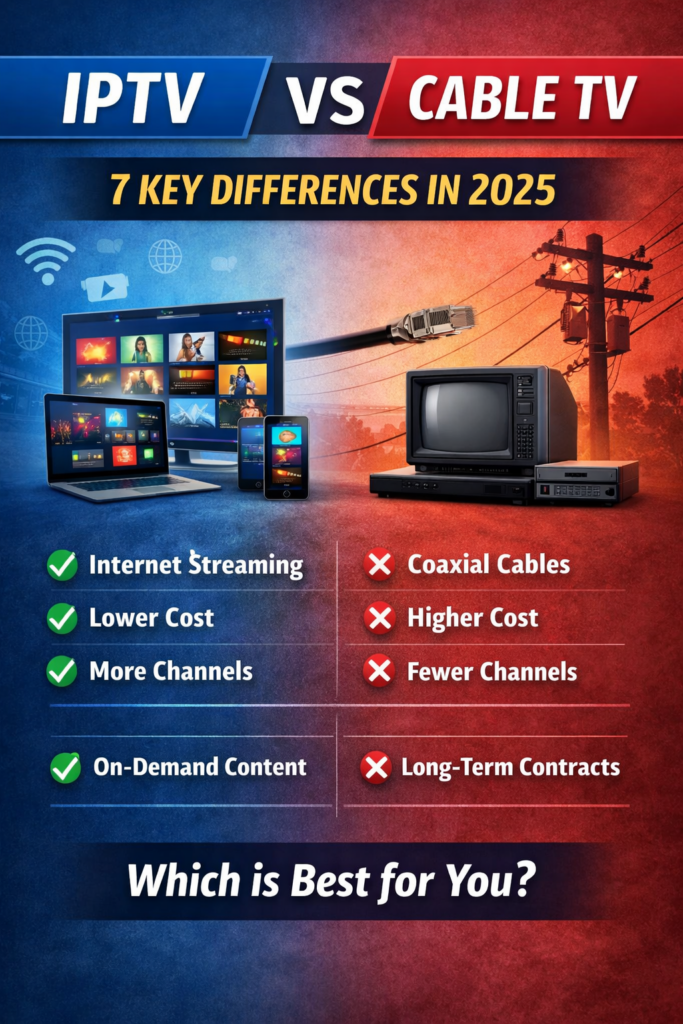
IPTV vs Cable TV comparison explained in depth—discover 7 powerful differences, costs, features, pros, cons, and expert insights to choose smarter in 2026.
Introduction to IPTV vs Cable TV Comparison
The IPTV vs Cable TV comparison has become one of the hottest discussions in home entertainment. In 2025, viewers want flexibility, value, and control. Traditional cable TV once ruled the living room, but IPTV has changed the game—and fast.
Simply put, IPTV delivers television content over the internet, while cable TV relies on physical coaxial cables. At first glance, both seem to do the same thing: deliver channels to your screen. However, once you dig deeper, the differences are impossible to ignore.
This IPTV vs Cable TV comparison matters because it affects your monthly budget, viewing habits, and even how many devices you can use at once. People are cutting the cord left and right, yet cable still holds strong in certain regions.
In this guide, we’ll break things down in plain English. No tech jargon overload. No sales hype. Just real facts, expert insight, and practical comparisons so you can decide what actually works best for you.
What Is IPTV?
How IPTV Works
IPTV stands for Internet Protocol Television. Instead of broadcasting through satellite signals or cable lines, IPTV streams content using your internet connection. Think of it like Netflix—but for live TV channels too.
Content is delivered through secure servers and played instantly on compatible apps or devices. Because it’s internet-based, IPTV doesn’t follow fixed schedules the same way cable does. You choose what to watch and when.
Types of IPTV Services
There are three main IPTV formats:
- Live IPTV: Real-time TV channels
- Video on Demand (VOD): Movies and series anytime
- Time-Shifted TV: Catch-up and replay features
This flexibility is a major factor in the ongoing IPTV vs Cable TV comparison, especially for busy households.
What Is Cable TV?
How Cable TV Works
Cable TV uses underground or aerial coaxial cables to deliver signals directly to your home. These signals are broadcast simultaneously to all subscribers, which means limited customization.
Unlike IPTV, cable TV doesn’t rely on internet speed. Instead, it depends on physical infrastructure maintained by providers.
Traditional Cable Packages
Cable providers bundle channels into fixed packages. Want sports but not kids’ TV? Too bad—you often pay for both. While stable, this rigidity is why many users rethink cable when doing an IPTV vs Cable TV comparison.
IPTV vs Cable TV: Technology Comparison
### Streaming Protocols vs Coaxial Networks
IPTV uses modern streaming protocols like HLS and MPEG-DASH. Cable TV relies on older RF broadcasting methods. The result? IPTV adapts better to high-definition and 4K content.
### Reliability and Infrastructure
Cable TV performs well during peak hours, but outages affect entire neighborhoods. IPTV depends on your internet quality—fast fiber equals smooth streaming.
IPTV vs Cable TV Pricing and Value
When people start an IPTV vs Cable TV comparison, pricing is usually the deal-breaker. And honestly, it’s where the contrast becomes crystal clear.
Cable TV subscriptions are expensive. On average, users pay between $70 and $120 per month. That price often excludes premium channels, DVR services, and equipment rentals. Add those extras, and the bill climbs fast.
IPTV, on the other hand, is far more flexible. Most IPTV services range from $10 to $25 per month. Many include thousands of channels, VOD libraries, and multi-device access. No long-term contracts. No installation fees.
Another big difference is hidden costs. Cable companies love fine print—activation fees, regional sports fees, and early termination penalties. IPTV providers usually offer straightforward pricing.
From a value standpoint, IPTV wins for users who want more content at a lower cost. Still, cable may appeal to users who prioritize local support and bundled internet deals.
In this IPTV vs Cable TV comparison, pricing alone has convinced millions to switch.
IPTV vs Cable TV Channel Variety and Content
Content is king, right? And this is where the IPTV vs Cable TV comparison gets interesting.
Cable TV focuses heavily on local and national channels. You’ll get major networks, regional sports, and local news. However, international content is limited and often costs extra.
IPTV shines in global variety. Many services offer:
- International channels
- Premium sports packages
- Massive VOD libraries
- Niche content unavailable on cable
Sports fans especially notice the difference. IPTV often includes pay-per-view events and international leagues at no extra cost.
That said, cable TV remains strong for local programming and emergency broadcasts. For some users, that’s still a big plus.
IPTV vs Cable TV User Experience
User experience can make or break your viewing habits, and it’s a core part of any IPTV vs Cable TV comparison.
IPTV apps usually feature modern interfaces, search tools, and personalized recommendations. You can watch on smart TVs, smartphones, tablets, laptops, and streaming devices.
Cable TV interfaces feel dated by comparison. Navigation is slower, customization is limited, and watching on multiple devices often costs extra.
IPTV also supports features like:
- Pause and rewind live TV
- Multi-screen viewing
- Cloud-based favorites
If convenience matters, IPTV clearly leads.
IPTV vs Cable TV Legal and Security Considerations
Legality is an important topic in the IPTV vs Cable TV comparison. Cable TV operates under strict regulations and licensing agreements. It’s fully legal and monitored.
IPTV legality depends on the provider. Licensed IPTV services are legal, while unlicensed ones operate in gray areas. Users should always verify legitimacy.
For official guidance on broadcasting regulations, you can refer to the U.S. Federal Communications Commission (FCC):
👉 https://www.fcc.gov
Security-wise, IPTV users should use strong passwords and, in some regions, a VPN for privacy.
IPTV vs Cable TV Pros and Cons
IPTV Pros
- Lower cost
- Massive content variety
- Multi-device support
IPTV Cons
- Depends on internet quality
- Legal risks with unlicensed providers
Cable TV Pros
- Stable signal
- Fully regulated
Cable TV Cons
- High cost
- Limited flexibility
IPTV vs Cable TV: Which Is Better in 2025?
So, which one wins the IPTV vs Cable TV comparison in 2025? For most users, IPTV offers better value, flexibility, and content variety. Cable TV still suits users who want simplicity and guaranteed legality.
Ultimately, the best choice depends on your viewing habits, budget, and internet quality.
Frequently Asked Questions (FAQs)
1. Is IPTV better than cable TV?
Yes, for most users seeking affordability and variety, IPTV is better.
2. Is IPTV legal?
Licensed IPTV services are legal. Always verify the provider.
3. Does IPTV require fast internet?
Yes. A stable 20–30 Mbps connection is recommended.
4. Why is cable TV more expensive?
Infrastructure costs, licensing fees, and bundled services raise prices.
5. Can IPTV replace cable TV completely?
For many households, yes—especially with smart TVs.
6. Which has more channels, IPTV or cable?
IPTV usually offers significantly more channels.
Conclusion
This IPTV vs Cable TV comparison shows a clear shift in how people consume television. IPTV delivers freedom, value, and modern features, while cable TV offers stability and tradition.
As technology evolves, IPTV continues to gain ground. Still, the smartest choice is the one that fits your lifestyle best.